
the founder
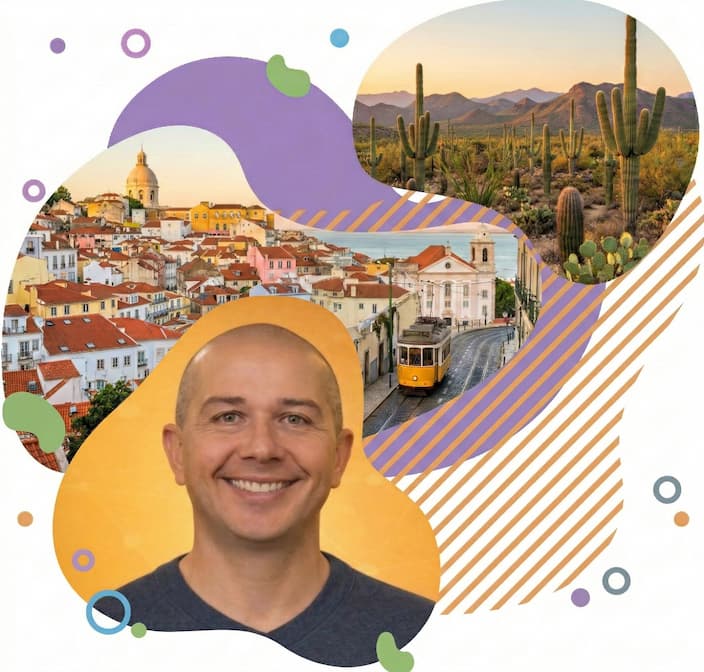
Jorge Pablos has been building software for over 20 years — across Mexico, the US, the UK, and Portugal. Not as a manager who lost touch with the code, but as a hands-on technologist who kept coding while leading.
Over two decades, he founded a real estate platform from scratch, managed high-traffic internet brands, and then spent 11 years at one e-commerce company — growing a team from 3 to 30, architecting a platform that generated tens of millions in revenue and shipped to over 180 countries, and leading cloud transformations across continents. He earned certifications across disciplines — from cloud architecture to DevOps, AI to agile — not to collect credentials, but because he saw gaps and refused to lead around them. He built things that lasted.
That’s the CV version. LinkedIn →
The stretch
During his 11-year tenure at a US-based e-commerce company, Jorge’s responsibilities never stopped growing. He went from coding to architecting, from architecting to leading distributed teams across Arizona, Mexico, India, and Ukraine — first from the US, then remotely from London as the communication bridge across three time zones.
He founded the DevOps function. He introduced a data practice, partnering with external firms to fill gaps. He introduced Scrum, led initiatives to break the monolith into services, and drove the migration to AWS — some succeeded, some stalled. He managed vendors, hired internationally, and coordinated with C-suite stakeholders — building the e-commerce platform that fulfilled orders and shipped to over 180 countries.

He wore every hat the growing organization needed — product thinking, cloud strategy, team dynamics, process design — because he felt responsible for making it work.

But something was always nagging. The bigger the operation got, the harder it became to keep strategy connected to execution. Knowledge lived in people’s heads. Decisions made in one room never reached another. Without clear structure and responsibilities, misalignment grew naturally. People optimized for their own context instead of shared outcomes. Everyone was working hard — but not always in the same direction.
Jorge pushed for better processes, better communication, clearer ownership. He studied everything he thought would help — Scrum, cloud architecture, microservices, team topologies. Some of it worked. But the dysfunction ran deeper than any one fix could reach — it was structural, not personal. Eventually, the chapter closed. Not with a clean ending, but with an honest one: the problems were real, the environment couldn’t solve them, and the questions they raised were too important to let go.
The questions That stayed
After leaving, the questions didn’t stop — but neither did the uncertainty. After eleven years of wearing every hat, Jorge didn’t know what he was anymore. Engineer? Architect? Manager? All of them and none of them at once. His skills felt stretched thin across too many fronts.
So he went back to his roots. Technology had always grounded him — the craft he could return to when everything else was noise. He earned certifications, took consulting work, rebuilt his technical foundation layer by layer. It was slow. It was deliberate. And through it, a bigger realization emerged: the experience he’d been diminishing — because it came from practice and pain, not formal training — was real, valuable, and rare. He didn’t need to shrink from it. He needed to grow what was missing.


That decision changed everything — not what came after, but the decision itself. To stop diminishing what he knew and start growing what was missing. In October 2025, Jorge joined the Cambridge University CTO Programme, a year-long executive programme focused on technology strategy, innovation portfolios, and leadership. Not as a credential — as a commitment to becoming the leader his experience had been preparing him to be. Along the way, it clicked: every module lands differently because he’s lived the problems Cambridge is teaching. The gap he’d felt for years finally has names: strategy-to-execution flow. Organizational structure driving behavior. Feedback loops that connect every layer.
The missing piece wasn’t effort or talent — it was the system itself.
why now
AI changed the economics of building. The cost collapsed. The speed exploded. But Jorge saw something else: an industry racing to replace people instead of empowering them.
Labinhood was built on a different conviction — that the best outcomes come from humans and AI working together, and that technology should elevate people, not remove them from the equation.